
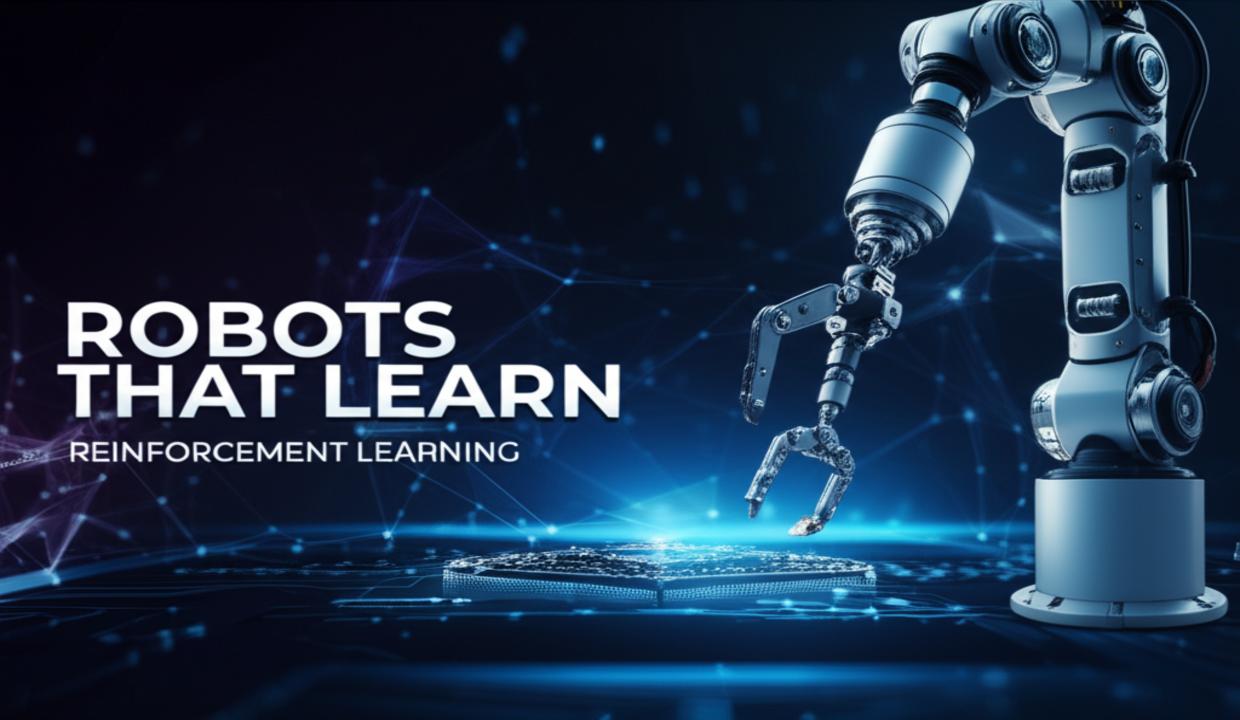
Imagine robots that learn like children, experimenting with their environment, making mistakes, and ultimately mastering complex tasks without explicit programming for every single scenario. This isn’t science fiction anymore. It’s the reality being shaped by reinforcement learning (RL), a revolutionary branch of artificial intelligence. It’s fundamentally transforming how we conceive, design, and deploy robotic systems.
For decades, robots relied on meticulously pre-programmed instructions, limiting their adaptability to unexpected situations. But with the advent of robot learning through RL, machines are gaining the ability to autonomously discover optimal strategies. This article will explore how reinforcement learning is reshaping the landscape of robotics, from its core principles to its real-world applications and future potential.
The Core of Robot Learning: How Reinforcement Learning Works
At its heart, reinforcement learning allows a robot, often called an “agent,” to learn adaptive, complex behaviors through trial and error. Picture a robot arm attempting to pick up an object. Instead of being told exactly which joint angles to achieve at each millisecond, it’s given a “reward” when it successfully grasps the object and a “penalty” if it drops it or fails. Over countless trials, the robot figures out the optimal sequence of actions to maximize its cumulative reward.
This process involves a delicate balance between “exploration” – trying new, untested behaviors to discover better strategies – and “exploitation” – leveraging already successful behaviors. This continuous feedback loop helps the robot develop an evolving “policy,” which is essentially its strategy for action. This policy steadily improves its task performance autonomously, moving beyond the limitations of rigid, pre-defined programming.
Unlike traditional methods, RL doesn’t require a human to specify every movement. Instead, it defines the goal, and the robot learns the path to achieve it. This makes AI robotics incredibly powerful for tasks in dynamic, unpredictable environments.
Breakthroughs in AI Robotics: The Algorithms Driving Change
The journey of robot learning has seen significant algorithmic breakthroughs that have propelled reinforcement learning into practical application. Early RL methods struggled with the sheer complexity of real-world robotic tasks, which involve high-dimensional sensory inputs and continuous, intricate movements.
The integration of RL with deep learning, leading to fields like Deep RL, has been a game-changer. Algorithms such as Deep Q-Networks (DQNs) and Proximal Policy Optimization (PPO) have enabled robots to process vast amounts of sensory data. Think of inputs from cameras, lidar, and touch sensors. They can then translate this information into fine-grained control over their joint movements and locomotion.
These advances have allowed autonomous robots to scale to previously intractable challenges. They can now tackle complex manipulation, precise locomotion, and robust navigation in unstructured environments. The ability to handle high-dimensional spaces means robots can learn from raw sensor data directly, reducing the need for painstaking manual feature engineering.
Real-World Impact: Reinforcement Learning in Action
The theoretical promise of reinforcement learning is now manifesting in tangible real-world applications, reshaping various industries and aspects of daily life. The versatility of RL allows robots to adapt to variability, reducing the necessity for constant manual reprogramming and enhancing their generalization capabilities to novel tasks.
- Manipulation: In factories and warehouses, RL-trained robots are learning to grasp diverse and irregularly shaped objects in cluttered, dynamic settings. This overcomes the rigid limitations of fixed programming, leading to more flexible and efficient automation. For instance, robots can sort packages of varying sizes and materials with unprecedented adaptability. You can learn more about how reinforcement learning is applied in robotics here: How Does Reinforcement Learning Apply to Robotics.
- Navigation: Mobile robots and drones, from delivery bots to aerial surveillance vehicles, are leveraging RL to autonomously navigate complex terrains and obstacle courses. They can adapt in real-time to changes in the environment, such as moving people or shifting objects, making them ideal for unpredictable urban or disaster relief settings.
- Industrial Automation: RL is optimizing assembly line operations by dynamically improving the speed and accuracy of robotic tasks. This leads to increased throughput and reduced errors. Imagine a robot adjusting its welding parameters based on real-time feedback, ensuring perfect seams every time. This continuous learning enhances overall productivity.
- Damage Recovery: Perhaps one of the most astonishing applications is a robot’s ability to self-heal or recover from damage. If a robot sustains hardware faults, like a damaged motor or a broken limb, RL can enable it to relearn stable walking gaits or manipulation strategies without manual recalibration. This resilience ensures operational continuity even in challenging conditions. The Lamarr Institute provides more insights into this: Reinforcement Learning and Robotics.
These applications highlight how reinforcement learning offers continuous performance improvement through ongoing learning, a vital capability in fields like warehouse logistics, autonomous vehicles, and service robotics, where environments are inherently unpredictable and diverse.
The Future of Autonomous Robots: Potential and Challenges
The trajectory of reinforcement learning in robotics points towards even greater autonomy and sophistication. Future trends are squarely focused on enhancing the practicality and safety of deploying RL-powered systems in the real world.
One major area of focus is improving sample efficiency. Currently, RL models often require vast amounts of data and countless trials to learn effectively. Reducing the time and data needed for robots to acquire new skills is crucial for broader adoption. Think of a robot learning a new task in just a few attempts, rather than thousands.
Another critical aspect is ensuring safe real-world training. During the exploration phase, a robot might try suboptimal or even dangerous actions. Developing methods to constrain exploration within safe boundaries is paramount. This will prevent damage to the robot or its surroundings. For deeper dives into the challenges, Carnegie Mellon University’s research offers insights: Reinforcement Learning in Robotics.
Transfer learning, where knowledge gained from one task or environment is applied to another, also holds immense promise. This could drastically speed up the learning process for new tasks. Additionally, enhancing the interpretability of learned policies will allow engineers to understand why a robot makes certain decisions, fostering trust and enabling easier debugging.
Despite these promising potentials, challenges persist. Dealing with high-dimensional continuous state and action spaces remains computationally intensive. Bridging the “simulation-to-real-world” (sim2real) gap – where policies learned in a simulated environment don’t always perform perfectly in the physical world – is an ongoing hurdle. However, the rapid pace of research suggests these limitations will continue to be addressed.
Watch More in This Video
Delve deeper into how reinforcement learning is enabling robots to develop skills autonomously. This video showcases incredible demonstrations of RL-trained robotic arms performing complex manipulations and mobile robots navigating challenging environments, highlighting the breakthroughs achieved by combining RL with advanced sensor data and deep learning for real-time adaptation.
Pros and Cons of Reinforcement Learning in Robotics
| Pros | Cons |
|---|---|
| Enables autonomous learning of complex behaviors. | Requires vast amounts of data and computational power. |
| Adapts to dynamic, unpredictable environments. | Safety during exploration can be a significant challenge. |
| Reduces need for extensive manual programming. | High-dimensional spaces make learning slow and complex. |
| Offers continuous performance improvement over time. | Bridging the “sim-to-real” gap remains difficult. |
| Enhances generalization to new or unseen scenarios. | Interpretability of learned policies can be low. |
| Facilitates recovery from hardware faults. | Defining effective reward functions can be tricky. |
FAQ About Reinforcement Learning and Robotics
-
What is the primary advantage of reinforcement learning over traditional robot programming?
The main advantage is adaptability. Traditional programming requires explicit instructions for every scenario, which is impractical for complex, dynamic environments. RL allows robots to learn and adapt autonomously through trial and error, discovering optimal strategies without human pre-programming for every specific action.
-
Can reinforcement learning make robots safer?
While the exploration phase in RL can introduce safety challenges, ongoing research is focused on safe RL techniques. By learning adaptive behaviors, robots can potentially become safer in unpredictable human-robot interaction scenarios. They can learn to avoid collisions or react appropriately to unforeseen obstacles, enhancing overall safety.
-
How does “Deep Learning” fit into Reinforcement Learning for Robotics?
Deep Learning provides the “perception” and “representation” capabilities for RL agents. It allows robots to process high-dimensional sensory data (like camera images or lidar scans) and extract meaningful features. This enables RL algorithms to handle complex inputs and learn policies for continuous control tasks that would be impossible otherwise. This combination is often referred to as Deep Reinforcement Learning.
-
Is reinforcement learning only for industrial robots?
Not at all! While widely used in industrial automation for tasks like assembly and grasping, reinforcement learning is also crucial for autonomous vehicles, service robots (e.g., in hospitals or homes), surgical robots, and even search-and-rescue drones. Its ability to enable learning in diverse, unpredictable environments makes it applicable across almost any domain where robots operate.
-
What is “sim-to-real” in reinforcement learning?
“Sim-to-real” refers to the process of training an RL agent in a simulated environment and then deploying the learned policy on a real physical robot. This is often done to reduce the safety risks and costs of real-world training. However, bridging the gap between simulation and reality – accounting for physics discrepancies and sensor noise – remains a significant challenge that researchers are actively addressing.
Conclusion: The Dawn of Truly Autonomous Robotics
Reinforcement learning is undoubtedly a cornerstone technology in the evolution of modern robotics. By empowering robots with the ability to learn and adapt through experience, much like living organisms, RL is fundamentally expanding their autonomy and the breadth of their potential applications. From handling delicate manipulation tasks to navigating treacherous terrains and even recovering from physical damage, RL-powered robots are proving to be more versatile, robust, and intelligent than ever before.
As research continues to address challenges like sample efficiency, safety, and the sim-to-real gap, we can expect to see autonomous robots with unprecedented capabilities. The future of robot learning promises a world where robots seamlessly integrate into our lives and industries, tackling complex problems with flexible, learned intelligence. This marks a new era for AI robotics. Explore more about the impact of RL here: Robots That Learn From Experience. For further insights into how AI is shaping the future of robotics, check out this article: How AI Is Shaping the Future of Robotics. #AIRobotics
We hope this article has shed light on this fascinating field. Feel free to share your thoughts in the comments, or explore more fascinating topics on our About Us page. You can also Contact Us for any queries.
Disclaimer: All images and videos are sourced from public platforms like Google and YouTube. If any content belongs to you and you want credit or removal, please inform us via our contact page.